



Internet 2008 in numbers

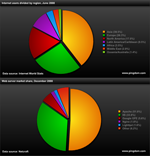 What happened with the Internet in 2008?
How many websites were added? How many emails were sent? How many blog posts were published? This post will answer those questions and many others with more interesting statistics than you can shake a stick at. 🙂
We have used a wide variety of sources from around the Web. A full list of source references is available at the bottom of the post for those interested.
 A new year has arrived, and we here at Pingdom have dived headlong into it. For example, just last week we
  The video-sharing site
  The blogging service
  Sometimes you just need to take a short break, relax and have fun. A great way to do so is to check out some funny web comics, and we here at Pingdom are big fans of comics that dive into the slightly more geeky aspects of life. Once a tech geek, always a tech geek…
 We all know that Wordpress is popular among bloggers, and Movable Type as well. But HOW popular? And what other platforms are being used? To find out, we went through the Technorati top 100 blogs and investigated what blog platforms they are using. It turned out to be a highly interesting survey with plenty of surprises along the way.
 We have released an iPhone application that can be used with the Pingdom uptime monitoring service. The aptly named Pingdom iPhone app lets you easily connect to Pingdom and view the current status of the monitoring you have set up.
 Remember “social search”? There has been plenty of buzz around this term in the past couple of years, but here’s a super-quick reminder from Wikipedia if you’re fuzzy on the details:
 CDNs (Content Delivery Networks) are becoming increasingly popular. The obvious benefit is that they can help websites to give end users a speedier web surfing experience, but there is also another very positive side effect for the entire Internet, and it will become more noticeable the more common CDNs become.
 Netvibes-competitor
  Lego started selling their now world-famous bricks 60 years ago, and has a certain inherent geek appeal (after all, Lego bricks are kind of like 3D pixels, and you can be endlessly creative with them).
 The Web has created its own set of words, but their popularity change over time. We have checked the trends for 45 different Web-related terms such as “social media”, “blogging”, “RSS”, “Web 2.0” and their like. For your convenience, we have collected the results in a handy, alphabetically sorted table that you can see below.
 It’s a common scenario: A new website launches after having built up a lot of hype around its service or product, only to almost immediately crash due to overwhelming traffic. These launch troubles are almost always scalability-related.
 Every year, companies find that someone has registered domain names involving their trademarks, or variations of their domain names that are confusingly similar to the original. If a solution can’t be found by talking to the registrant of the offending domain name(s), a formal dispute usually follows.
 First of all, a big thank you to all our readers. We hope we have been able to provide you with interesting, fun and thought-provoking articles over the past year, and if you have discovered this blog recently, thank you for joining our ranks!